
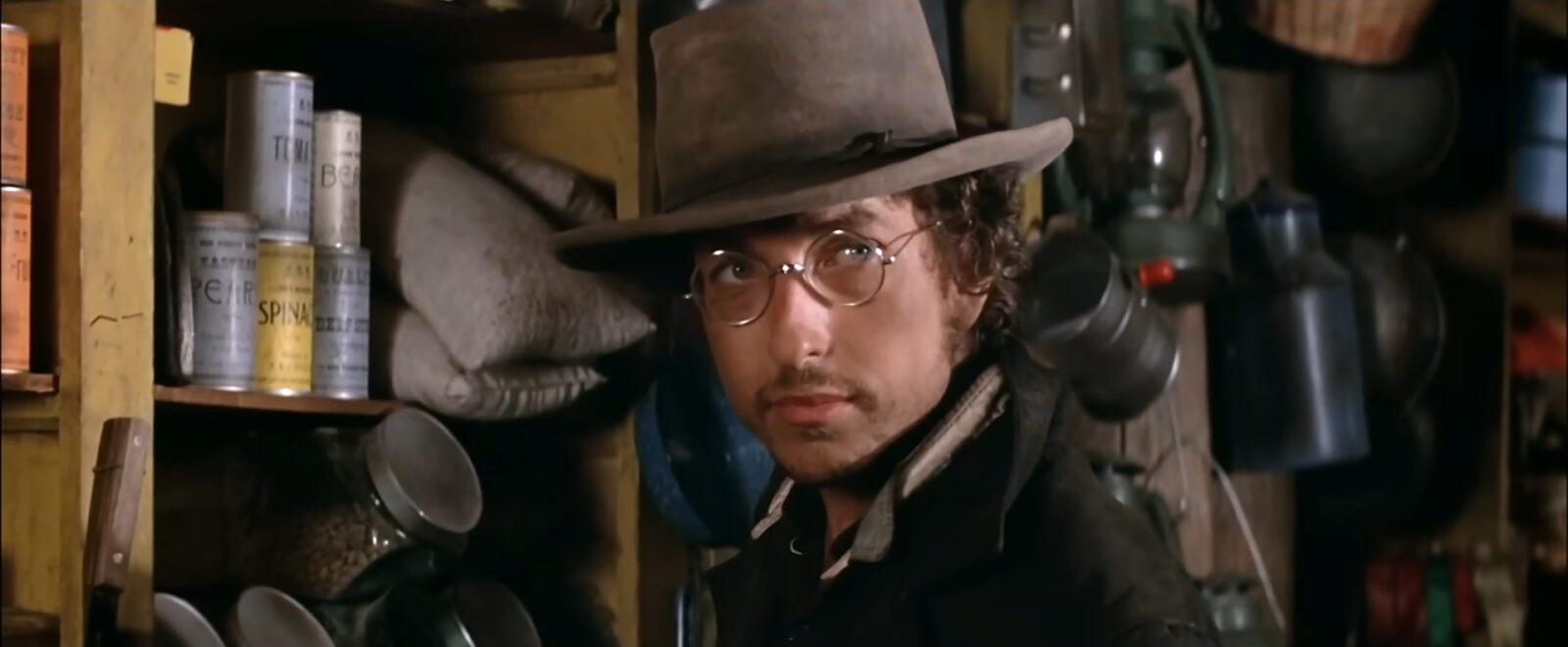

If Bob Dylan’s music is a hall of mirrors, fragmented truths, borrowed voices, and poetic riddles, then his life on film is a funhouse annex, full of reflections, distortions, and sly sideways glances. Dylan’s relationship with cinema spans over six decades, not just as a soundtrack supplier or mythic subject, but as a shape-shifting performer, reluctant documentary subject, occasional actor, and muse to a whole generation of filmmakers trying to decode the conundrum.
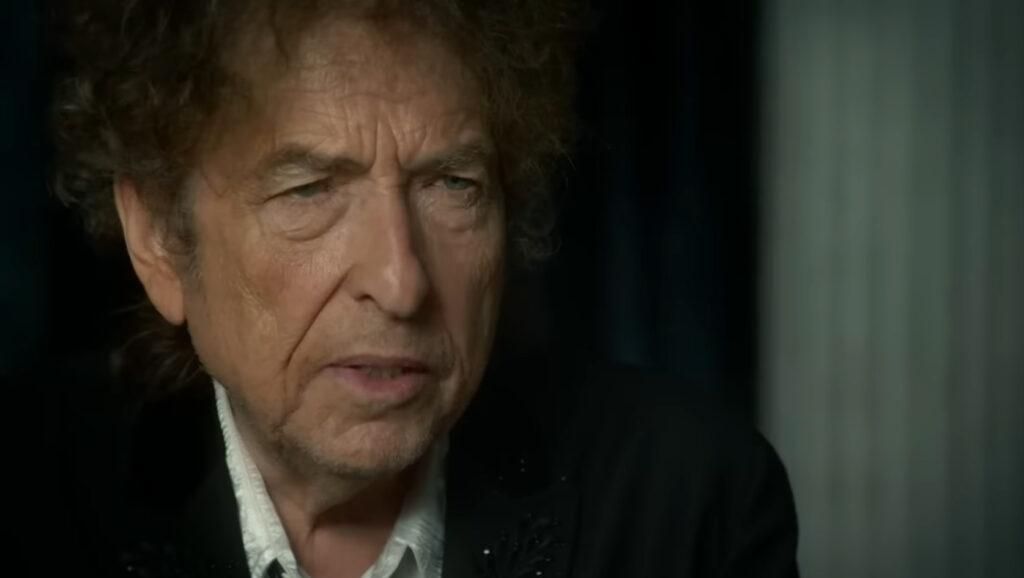
Let’s wander through the reels and roles; through the cinema vérité of D.A. Pennebaker’s lens, the strange stillness of Bob Dylan on screen, and the kaleidoscope of movies he has inspired. Popcorn not required, but a harmonica in the key of cinematic mischief might come in handy.
The Documentaries: Catching the Chameleon
Before he was the Nobel laureate of elliptical lyricism, Bob Dylan was a camera magnet. His early tours, particularly the UK run in 1965, became the fodder for one of the most influential music documentaries ever made: Don’t Look Back (1967), directed by the vérité godfather himself, D.A. Pennebaker.
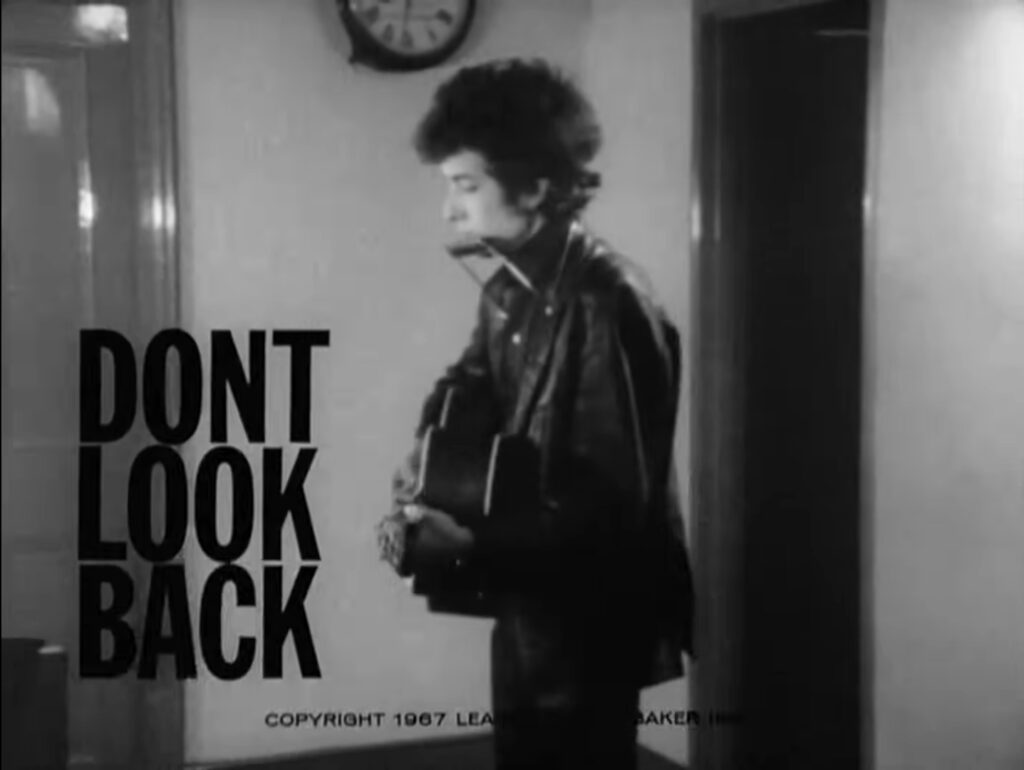
Here, Bob Dylan is caught at a pivotal moment—shedding his folk prophet skin and slipping into electric, amp-fried alienation. Pennebaker’s camera trails Dylan through press conferences, hotel rooms, and backstage corridors. The most famous scene—Dylan flipping cue cards for “Subterranean Homesick Blues” in a dank alley with Allen Ginsberg lurking in the background—is arguably the first music video ever made. But Don’t Look Back isn’t interested in performance as much as it is in persona: Dylan is sarcastic, aloof, vulnerable, and razor-sharp, all at once. You never get closer to the real Bob Dylan than this—and yet, you suspect you’re only seeing a glimpse of what he wants you to see.
That tension between access and artifice is even more pronounced in Eat the Document (1972), a chaotic, often surreal self-directed follow-up to Don’t Look Back that documents the even more infamous 1966 tour—the one where Dylan went electric, got booed nightly, and practically invented the postmodern rock performance. The film was commissioned by ABC but deemed too strange to air. It features snippets of backstage revelry, including a now-legendary, semi-incoherent back-seat-of-a-car exchange with John Lennon that’s part comedy, part cautionary tale.
Then there’s No Direction Home (2005), Martin Scorsese’s gorgeously assembled, decades-spanning documentary that paints a more linear, elegiac picture of Dylan’s early rise. With candid interviews (including from Dylan himself, looking like a weather-beaten poet laureate from Mars), vintage performances, and archival gold. Scorsese creates a kind of mythological hero’s journey—from Minnesota’s Iron Range to Greenwich Village, from Woody Guthrie acolyte to messianic rock ‘n’ roll antihero.
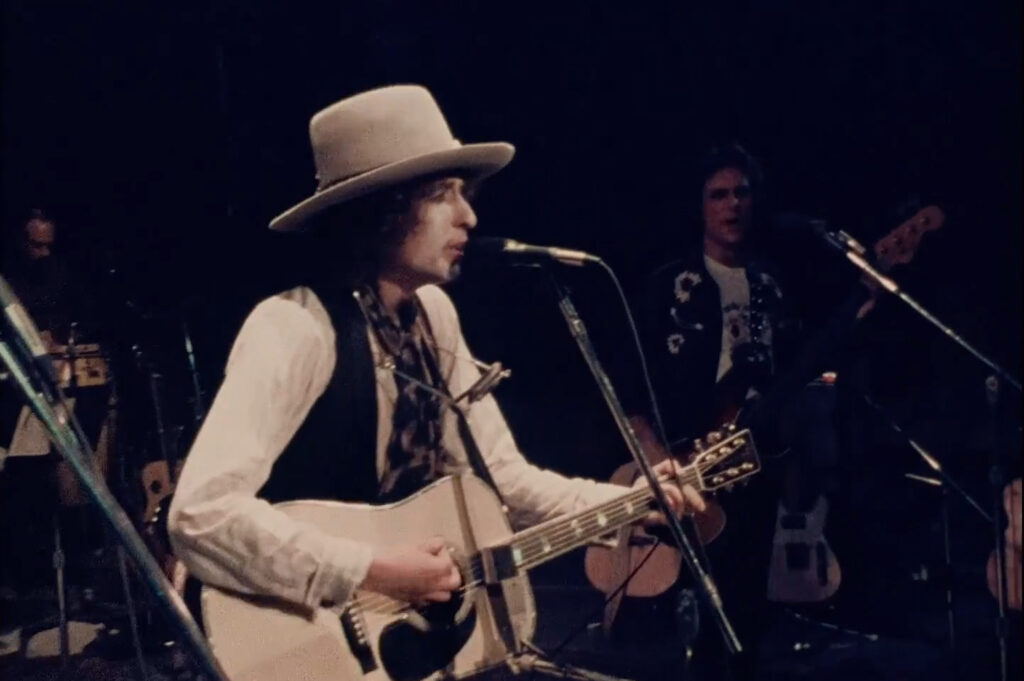
Scorsese returned to the Dylan well with Rolling Thunder Revue: A Bob Dylan Story (2019), but this time with a twist: the documentary is peppered with fictionalized elements and outright lies. Characters are invented. Events are misremembered. Sharon Stone is in it—for some reason. The message? Dylan can’t be nailed down. Not by history, not by film, not even by Marty Scorsese.
The entire film seems to be an exercise in misdirection. A slight-of-hand illusion that appears to be a bonifide chronicle of Dylan’s 1975 tour, but on further inspection is revealed to be a kaleidoscopic bricolage of actual events mixed-up with tall tales. There is a deeper meaning to it all, but by the time you figure it out, you may feel like you’ve been taken for a ride, proverbially and literally. One thing is for sure, this strange and singular movie is an entertaining two and half hours of Bob Dylan circus-style mayhem.
Dylan the Actor: Masked and Anonymous
Despite his undeniable magnetism, Bob Dylan the screen actor has always felt like a reluctant guest at someone else’s party—or maybe like the host who forgot his own address.
His first substantial acting role came in Pat Garrett and Billy the Kid (1973), Sam Peckinpah’s mournful Western in which Dylan plays a quiet, knife-wielding drifter named Alias. He’s more presence than character—hovering at the edge of the frame, staring into the distance, offering cryptic one-liners like a troubadour ghost. He also composed the film’s soundtrack, including the classic song “Knockin’ on Heaven’s Door,” which has outlived the movie by about five decades and counting.
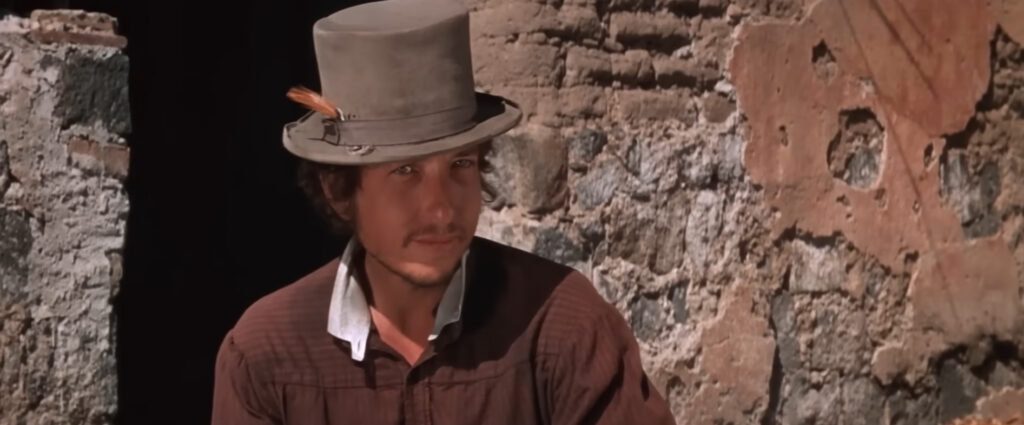
In 1978, Dylan co-wrote and starred in Renaldo and Clara (1978), a nearly four-hour, semi-improvised cinematic fever dream based on his Rolling Thunder Revue tour of 1975. Part concert film, part fictional psychodrama, it was a critical and commercial disaster. Dylan plays “Renaldo” (though he’s essentially himself), while then-wife Sara Dylan plays “Clara.” Joan Baez, Allen Ginsberg, and various tour members drift in and out. The film is notoriously difficult to pin down—equal parts self-portrait and self-sabotage. It’s often been compared to Fellini, though perhaps only because it makes about as much linear sense as 8½ on mescaline.
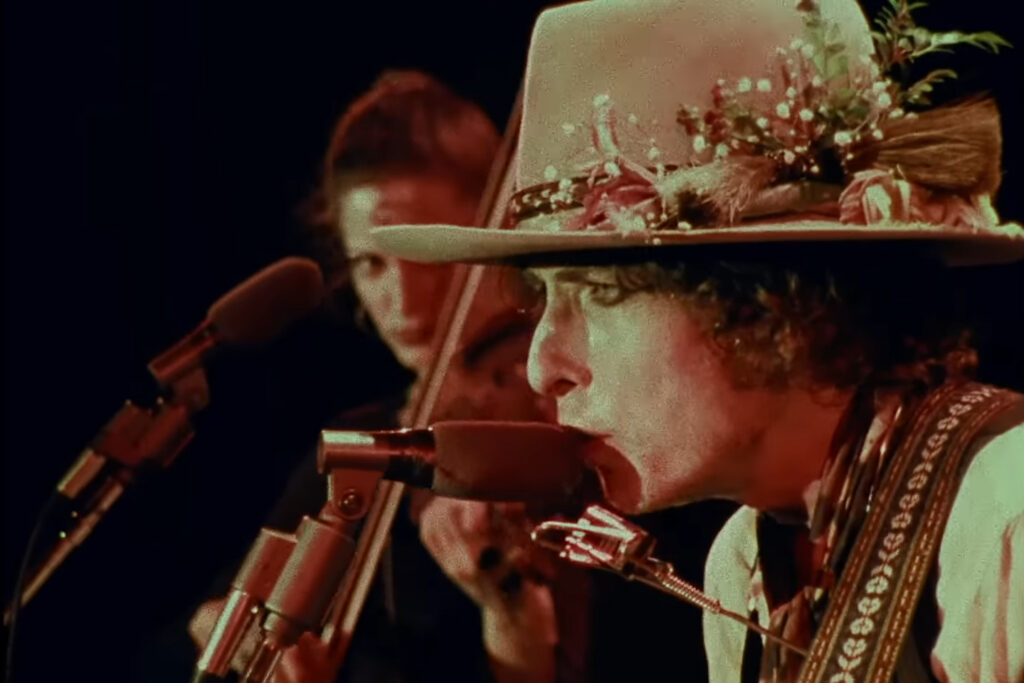
In 2003, Dylan returned to the screen in Masked and Anonymous (2003), directed by Larry Charles (Seinfeld, Borat). Set in a dystopian America (so, any Tuesday), Dylan plays “Jack Fate,” a legendary musician released from prison to perform a benefit concert. The cast is ludicrously star-studded—Jeff Bridges, John Goodman, Jessica Lange, Penélope Cruz, Ed Harris, even Christian Slater—all circling Dylan, who mumbles poetic riddles and shrugs through scenes like a mystical Zen cowboy. The film was panned by critics, but in retrospect, it feels more like a performance art piece than a failed narrative. Dylan doesn’t so much act as haunt the film.
He’s also popped up in a handful of cameos and archival appearances: from the obscure crime comedy/drama Catchfire (1990), to the magnificent The Last Waltz (1978), to countless other concert films. In all of them, he remains an oddity: unmistakably magnetic, never entirely comfortable.
Dylan-Inspired Cinema: Mirrors and Dopplegängers
If Dylan himself has always resisted definition, filmmakers have responded by throwing out the rulebook entirely. Perhaps no movie captures the multiplicity of Bob Dylan better than Todd Haynes’ I’m Not There (2007), a kaleidoscopic anti-biopic in which six different actors play different aspects of Dylan’s persona.
Christian Bale plays the protest singer. Cate Blanchett plays the electrified rebel. Heath Ledger is the movie star Dylan. Richard Gere is a Billy the Kid-type figure in a mythic western landscape. Marcus Carl Franklin plays a young boy who calls himself “Woody,” representing Dylan’s early Guthrie-obsessed days. Ben Whishaw channels the Rimbaud-like poet Dylan.
The film doesn’t so much tell Dylan’s story as refract it—through time, identity, and imagination. The result is a cinematic Rorschach test: part documentary, part hallucination, all homage. I’m Not There is as much about the idea of Dylan as the man himself—the result is arguably the most accurate Bob Dylan portrait of all.
Recently released A Complete Unknown (2024) is James Mangold’s biopic starring Timothée Chalamet as a young Dylan arriving in Greenwich Village and transforming into a cultural atom bomb. With a supporting cast featuring Monica Barbaro as Joan Baez and Elle Fanning as Dylan’s love interest and Edward Norton as Pete Seeger, the film focuses on Bob’s early evolution rather than attempting a cradle-to-the-grave epic. Mangold has cited I’m Not There as a touchstone, suggesting that his film also avoids traditional biopic tropes. Chalamet does all his own singing as does Barbaro. The sets, costumes and events portrayed are all reasonably accurate, but as for the details of the story, it remains as exaggerated and jumbled-up as any other Bob Dylan adjacent movies.
Take a look at this excerpt video from one of our podcast episodes where we discuss A Complete Unknown after seeing it for the first time…
The Verdict: Never Straight, Always True
Trying to make sense of Dylan’s cinematic presence is like trying to catch a train that doesn’t believe in tracks. He’s been captured in vérité grain, buried under layers of allegory, reborn in fiction, and reinvented by directors who saw him not as a person but a prism. He is both subject and saboteur, icon and illusion.
If rock and roll once promised revolution, Dylan’s films whisper something quieter: ambiguity is power. Dylan doesn’t use cinema to solidify his legacy. He uses it to destabilize it. In this way, he’s not just a participant in rock cinema—he’s one of its architects.
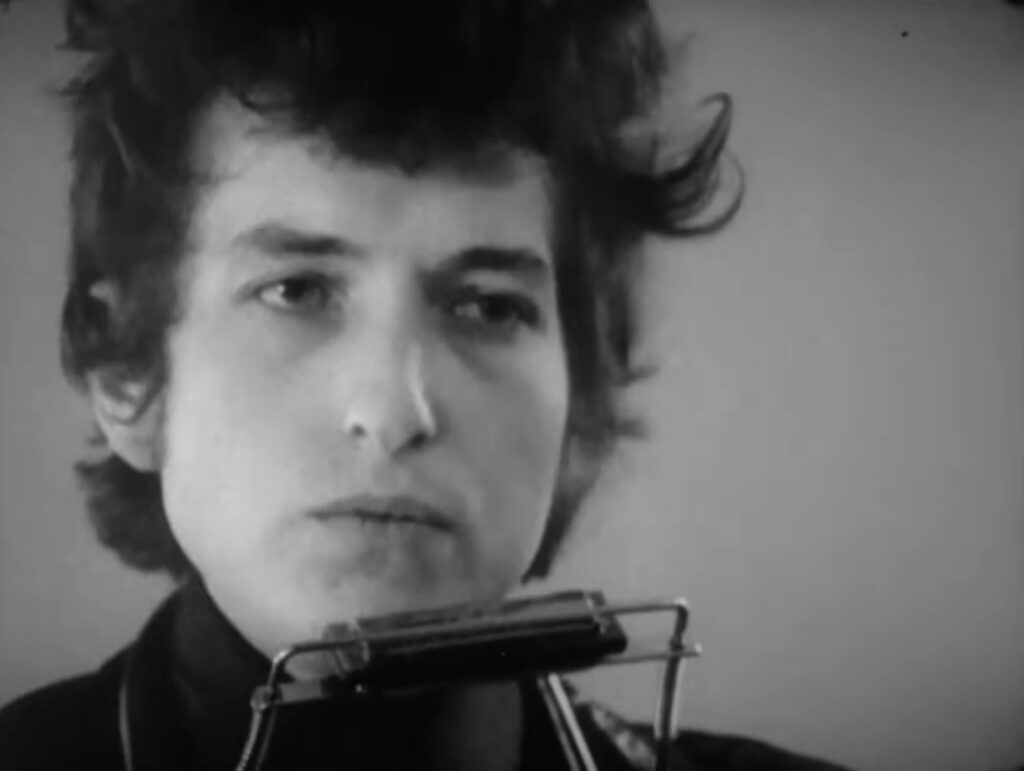
Dylan’s films, in all their oddity and brilliance, reflect the spirit of an era that refused to colour inside the lines. From Pennebaker’s fly-on-the-wall intimacy to Haynes’ imagined daydreams, they are chapters in a broader cultural autobiography. They remind us that the story is never as important as how it’s told—and that the man in the corner, scribbling notes on a napkin, may well be rewriting history while everyone else is filming it.
So go ahead—watch Dylan on film. Just don’t expect resolution. Expect riddles. Expect masks. Expect emotion. And maybe, if you’re lucky, a flash of that unknowable thing filmmaker’s have been chasing since 1963.
Whatever it is, it’s probably not there. But Bob Dylan was. And that’s enough.
That concludes our article about Bob Dylan on Film
Did you enjoy the article? Let us know in the comments down below!
For more episodes of More Movies Weekly as well as our other shows and podcasts, be sure to check out the Podcasts page on our website.
Remember, you can have a choice of what films we review on our Weekly podcast by joining us on Patreon here.
Please join us on social media on Bluesky, Instagram and Facebook. We really appreciate all the likes, shares, retweets etc., and we would love to hear from you and continue chatting about all things cinema on these platforms.
If you love to watch videos on YouTube, then please subscribe to our channel here. There’s lots of fun and informative videos uploaded that we hope you will enjoy!
We have a passion for movies and aim to produce entertaining and informative movie-related content. It certainly is a lot of hard work, but we love films so much that it’s worth all the effort. We have to keep the lights on and make sure we have plenty of caffeine to keep all of the articles, videos and social media posts coming, so if you like our work, then please consider supporting us at Buy Me A Coffee here. You can also become a More Movies patron on Patreon here.
To help support us here at More Movies, we do use advertising in a few places and we try our best to make sure they are not intrusive or aggressive, so we appreciate it if you do not use AdBlockers on our site. Who knows, you may actually see something you like!
We are also affiliated with Funky T-shirts so be sure to check out their range of cool t-shirts which include categories Film & TV, Slogans and Retro Comics!